Focus and hyperactivity deficiency syndrome (ADHD) is a disorder of the nervous system that affects the behavior, concentration and teaching of children. Children with ADHD are inattention, high distracting, excessive motor activity, impulsive behavior, and communication problems.

Mexidol: Use of the drug
in the treatment of attention deficit
hyperactivity disorder (ADHD)

The drug Mexidol®, with attention deficiency syndrome, showed high efficiency and safety (practically no side effects). Thanks to this, Mexidol® for ADHD is widely used in pediatrics.
What is attention deficiency and hyperactivity disorder (ADHD)?
How often and who has ADHD?
ADHD is diagnosed in approximately 5–15% of children [1, 2]. The syndrome is approximately three times more common in boys than in girls [3]. Adults are less likely to suffer from the syndrome. After age 18, the prevalence fluctuates between 4–5% [4]. Diagnosis is most often made when a child begins school [5]. However, signs of ADHD are usually noticeable as early as preschool age.
Causes of ADHD
- СДВГ имеет тенденцию передаваться по наследству. Этот факт подтвержден более чем у 50 % пациентов [6][7]. Генетическую зависимость имеют биохимические механизмы, связанные с нарушением функции нейромедиаторных систем головного мозга. Дисбаланс обмена катехоламинов (норадреналина, дофамина и серотонина) и их окисление приводит к образованию свободных радикалов [8][9][10]. Таким образом, развивается окислительный стресс, продукты которого оказывают негативное действие на мозговые клетки. Это и является причиной СДВГ. Также имеют значение нейропсихологические особенности: замедленное формирование исполнительских функций, созревание префронтальной коры.
- Органические факторы. Сложное протекание беременности и родов у матери, хроническая гипоксия плода, недоношенность, внутриутробная инфекция и другие факторы могут стать причиной СДВГ
- Социально-психологические факторы. Им отводится важная, но не ключевая роль в формировании СДВГ. Низкое социальное положение или тяжелые разногласия внутри семьи, алкоголизм у родителей, несбалансированное питание ребенка, а также загрязнение окружающей среды микроэлементами тяжелых металлов, например, свинца, могут вызывать расстройства поведения у детей [7].
Clinical forms of ADHD
Modern classification distinguishes three types of ADHD:
-
1
predominantly inattentive
20–30% of cases, more often detected
in adolescents; -
2
predominantly hyperactive/impulsive
15% of cases, more often determined
in preschool children; -
3
mixed
50–75% (the most common form), all groups of symptoms are present [1,11].
Symptoms of ADHD
Most often, the mixed form of ADHD in children begins to manifest itself as early as 3-4 years of age. The child is easily excited, gets carried away in play, and may exhibit impatience (trying to get what they want as quickly as possible, interrupting others). Impulsive behavior can cause injury to themselves or others. Often, with this form of ADHD, children are unable to admit defeat in games and react excessively emotionally or even aggressively.
An emotional outburst is followed by fatigue, which manifests itself as tearfulness and moodiness, and may also lead to sleep problems. Parents often describe this condition as "overexcited."
Children with ADHD consistently experience academic difficulties. Learning is primarily hampered by restlessness, an inability to concentrate on assigned tasks, and a failure to complete them. The child suffers from forgetfulness and absent-mindedness. For example, they may run with a specific goal in mind during a game, only to become distracted by something along the way. The child's attention quickly switches. This particularly interferes with learning skills such as reading and arithmetic. They quickly get bored with such activities, and their attention moves to other things.
Thus, the key symptoms of ADHD are inattention or attention deficit, hyperactivity and impulsiveness [5]. Inattention becomes noticeable when the child encounters tasks requiring a thorough study of the task, a quick reaction, perception of visual and verbal information, and concentration of attention. Impulsiveness is manifested in the form of hasty actions that can lead to undesirable results (for example, children who run around without looking back the carriageway). Hyperactivity is determined by excessive motor activity and creates problems with perseverance both during classes and during leisure hours, for example, when reading or watching films. ADHD does not affect the intellect of the child, but greatly complicates the educational process, interferes with being disciplined and fulfilling the requirements of the teacher.

Кто ставит диагноз СДВГ?

The activity or moodiness of the child is not a sign of ADHD. Only doctors who focus on modern approaches to the diagnosis of this disease can make an accurate diagnosis [5].
Diagnosis of ADHD
There are special criteria to make a diagnosis. They take into account the patient's age, symptoms and its duration. Symptoms should be observed at least 6 months, have an early age of manifestations - up to 7 years, extend to all spheres of life. The diagnosis of ADHD, according to the criteria for the international classification of diseases of the 10th revision, can be established if at least 6 of the inattention symptoms listed below, 3 symptoms of hyperactivity and 1 symptom of impulsivity [5].
Symptoms of inattention:
- The child is not able to fix attention on the details, makes many mistakes.
- He has difficulty maintaining attention when doing schoolwork
or playing. - He does not listen to speech addressed to him.
- Cannot follow the instructions and bring the matter to the end.
- He cannot plan and complete the tasks.
- Avoids the implementation of cases requiring long -term mental stress.
- Often loses his things.
- Easily distracted.
- Shows forgetfulness.
Symptoms of hyperactivity:
- The child has restless movements, he is constantly spinning and spinning.
- It cannot sit still when the rules require this.
- The child shows excessive and aimless motor activity in unacceptable situations.
- He cannot play quietly and calmly.
- Located in constant movement.
- It is distinguished by talkativeness.
Symptoms of impulsiveness:
- The child without hesitation answers questions.
- Can't wait for his turn.
- It interferes with others and intervenes in conversations and games.
Прогноз СДВГ
In most cases, ADHD has a favorable prognosis. As a child matures, the neurotransmitter imbalance in the brain's system is fully or partially compensated. This helps reduce the severity of many of the syndrome's symptoms by adolescence. However, the clinical picture of ADHD can also be observed in adults. ADHD may have an unfavorable prognosis when combined with other mental illnesses. Successful social adaptation of children with ADHD requires collaboration between specialists in various fields, the school, and the family [5].
How to treat ADHD?
Лечение СДВГ должно быть комплексом мер, которые учитывают индивидуальные особенности ребенка. В расчет берется ключевая причина заболевания, звенья патогенеза, клиническая картина, наличие коморбидных заболеваний. Важнейшая цель лечения заключается в устранении или снижении выраженности симптомов болезни. Это необходимо для повышения качества жизни и адаптации ребенка в социуме. Наиболее эффективным методом лечения СДВГ на сегодняшний день считается сочетание лекарственной и поведенческой терапии с семейной психотерапией и психолого-педагогической коррекцией [7][12]. В качестве медикаментозного лечения в терапии СДВГ в Российской Федерации применяются атомоксетин, ноотропные препараты различных групп (производные пирролидона, гамма-аминомасляной кислоты, нейропептиды, многокомпонентные лекарственные средства).
При выраженной гиперактивности и сопутствующих расстройствах поведения могут назначаться нейролептики [5, 13]. Перспективно сказывается применение препаратов, направленных на снижение окислительного стресса и защиту клеток мозга от свободных радикалов [14].
Мексидол® — оригинальный российский антиоксидант и антигипоксант прямого энергизирующего действия с широким спектром фармакологических эффектов. Мексидол® состоит из двух связанных и функционально значимых соединений: 2-этил-6-метил-3-гидроксипиридина и сукцината, сочетание которых обусловливает его мультимодальные свойства. Мексидол® при синдроме дефицита внимания и гиперактивности проявляет антиоксидантный, антигипоксантный, и мембраностабилизирующий эффекты. Благодаря данному сочетанию препарат обладает широким спектром мультимодальных свойств, такими как ноотропный, антиамнестический, противотревожный и другие клинические эффекты. Мексидол® имеет высокий профиль безопасности и практически не оказывает побочных эффектов [15][16].
Мексидол® — современный нейрометаболический препарат, который находит широкое применение в педиатрической практике [17].
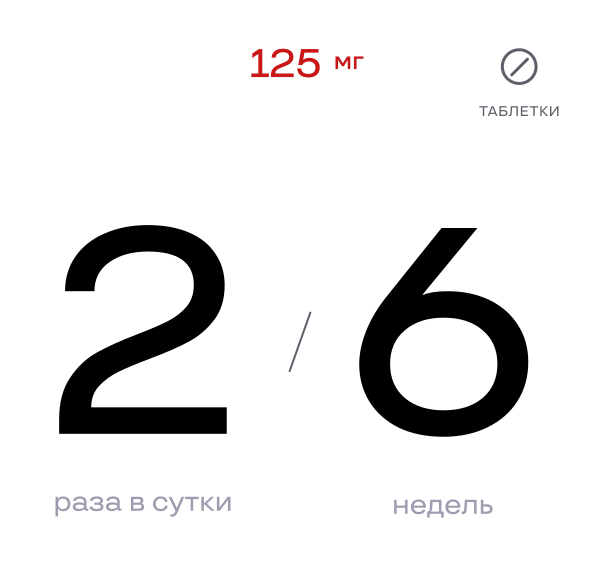
Проведенное многоцентровое двойное слепое рандомизированное плацебо-контролируемое в трёх параллельных группах клиническое исследование препарата Мексидол® в лечении СДВГ у детей в возрасте от 6 до 12 лет показало преимущество препарата над плацебо при оценке основного и большинства вторичных критериев эффективности и большую эффективность схемы лечения Мексидол® таблетки, покрытые пленочной оболочкой, 125 мг 2 раза в день перед схемой 125 мг 1 раз в день.
Reliable clinical efficiency was demonstrated by:
- The sum of the total score on the scales of SNAP-IV “Inattention”, “Hyperactivity/impulsivity”. Compared to the initial level, the indicator decreased by 29 %;
- the indicators on the SNAP-IV scales compared to the initial level: “Inattention”-26.3 %, “Hyperactivity/impulsivity”-33.3 %, 33.3 %in terms of Conance index;
- The average change in the general assessment of SDVG symptoms on the ADHD Rating Scale-IV scale. Compared to the initial level, the change was 30.4 %;
- Assessment on the scale of the general clinical impression of the severity of ADHG (The Clinical Global Impressions-DHD-SEVERITY CGI-DHD-S)-52.3 % of patients with ADHG went into a light group;
- The assessment of the general clinical impression (The Clinical Global Impressions Scale-IMPROVEMENT, CGI-I)-improvement or significant improvement was noted in 52.2 % of patients.
A high use safety profile and good tolerance of the drug Mexidol® were also demonstrated
Based on the results of a clinical study of the use of Mexidol® for attention deficit syndrome, it was found that against the background of the use of Mexidol®, after 6 weeks of therapy, a comparable nature of the safety profiles of the testing of the drug Mexidol® and the placebo drug studied were obtained.
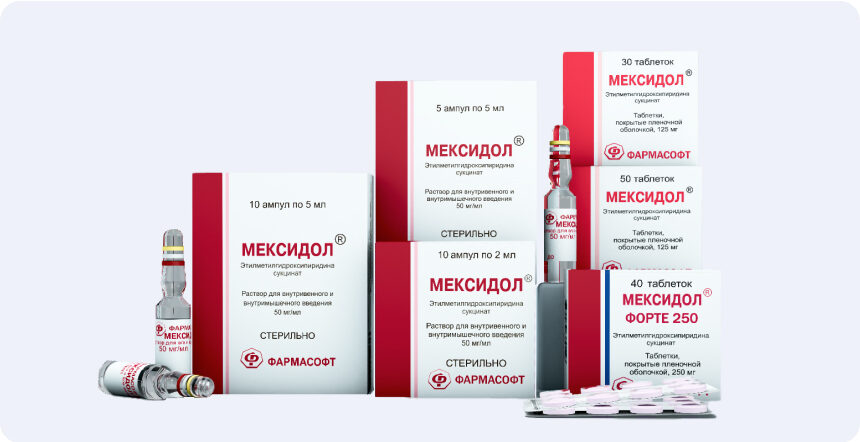
Эффективная схема терапии препаратом Мексидол® при СДВГ — по 1 таблетке 125 мг 2 раза в день в течение 1,5 месяцев [17, 18]. Стоимость 1,5-месячного курса препарата Мексидол® при приеме по 1 таблетке 125 мг 2 раза в день составляет менее 900 рублей, по данным apteka.ru.
Clinical experience in using Mexidol with ADHD:
- The results of a multicenter dual-blind randomized placebo-controlled clinical study on assessing the effectiveness and safety of the drug Mexidol in the treatment of attention deficit syndrome in children (mega) N. N. Journal of Neurology and Psychiatry, VOL. 122, no. 4.
- Zavadenko N. N., Suvorinova N. Yu., Zavadenko A. N. The possibilities of using Mexidol in neuropediatrics. Journal of neurology and psychiatry named after S. S. Korsakova. 2023; 123 (9 issue 2): 1–8.
How to take Mexidol® for ADHD?
Block of articles on this topic
List of literature
- Diagnostic and Statistical Manual of Mental Disorders, 5th Edition (DSM - V). American Psychiatric Association. - Washington. - 2013. - 947 p.
- Wolraich Ml, Hagan JF, Allan C, et al. AAP Subcommittee on Children and Adolescents with Atting-Deficit/Hyperaactive Disorder. Clinical Practice Guideline for the Diagnosis, EvalUation, and Treatment of Attend-Deficit/Hyperaactivity Disorder in Children and Adolescents. Pediatrics. 2019; 144 (4): E20192528.
- Zavadenko N.N. Syndrome of attention deficit and hyperactivity: modern principles of diagnosis and treatment // J. issues of modern pediatrics. - 2014. —T.13, No. 4. -S. 48-53
- Nureev I.T., Kirkin V.I., Glorokazova M.V. Syndrome of attention deficit and hyperactivity in adults, its diagnosis and influence on the success of students' educational activities (literature review) // Vyatka Medical Herald. 2012. No. 1.
- Federal State Budgetary Institution “Federal Medical Research Center for Psychiatry and Narcology named after V.P. Serbian "Ministry of Health of Russia. Hyperkinetic disorders (ADHD). Ed. Korin E.V., Kupriyanova T.A. 2015.
- Faraone SV, Perlis Rh, Doyle ae et al (2005). Molecular Genetics of Attenation-Deficit/Hyperaactivity Disorder // Biological Psychiatry-2005-No. 57.-P. 1313-1323.
- Gillberg Christopher. ADHD and Its Many Associated Problems. - Oxford University Press.– 2014. - 304 p.
- Alvarez-Ellano L, González-García N, Salazar-García M, Corona JC. Antioxidants as a Potential Target Against Inflammation and Oxidative Stress in Attention-Deficit/Hyperaactivity Disorder. Antioxidants. 2020; 9: 176.
- Corona JC. Role of Oxidate Stress and NeurinflamMation in Attendation-Deficit/Hyperaactivity Disorder. Antioxid Basel Switz. 2020; 9: E1039.
- Robberecht H, Verlaet Aaj, Breynaert a, et al. Copper and Selenium Status in Attendation-Deficit/Hyperaactivity Disorder (ADHD). Mol Basel Switz. 2020; 25: E4440.
- International Classification of Diseases (10th revision): Classification of mental and behavioral disorders: clinical descriptions and instructions for diagnosis: trans. on Russian. ulcer. / Ed. Yu.L.
- Fabiano Ga, Pelham We, Coles ek et al. A META-ANALYSIS OF Behavioral Treattions for Attendation-Deficit/Hyperactivity Disorder // Clinical Psychology Review. -2009.-No. 29.-P. 129-140.
- Zavadenko N.N. Hyperactivity and attention deficit in childhood. M.: Yuraite; 2019. Zavadenko NN. Hyperaactivity and Deficiency of Attenation At Children's Age. M.: Jurite; 2019. (In Russian).
- Curpan as, Luca AC, Ciobica A. Potential Novel Therapies for Neurodevelopmental Disesses Targeting Oxidation Stress. Oxid Med Cell Longev. 2021; 2021: 6640206.
- Fedin A.I., Zakharov V.V., Tanashyan M.M. et al. The results of an international multicenter randomized double-blind-controlled study of the assessment of the effectiveness of the effectiveness and safety of sequential therapy of patients with chronic brain ischemia with Mexidol and Mexidol Forte 250 (study of Memo). Journal of neurology and psychiatry named after S.S. Korsakova. 2021; 121 (11): 7-16
- Schulkin A.V. Modern ideas about the antihypoxic and antioxidant effects of Mexidol. Journal of neurology and psychiatry named after S.S. Korsakova. 2018; 118 (12, issue 2): 87–93.
- Zavadenko N.N., Suvorinova N.Yu., Zavadenko A.N. The possibilities of using Mexidol in neuropediatrics. Journal of neurology and psychiatry named after S.S. Korsakova. 2023; 123 (9 issue 2): 1–8.
- Zavadenko N.N., Suvorinova N.Yu., Batysheva T.T., Bykova O.V., Platonova A.N., Gainetdinova D.D., Levitina E.V., cars V.V., Vakula and Vakula and Vakula and .N., Maksimova N.E. The results of a multicenter dual blind randomized placebo-controlled clinical study on the assessment of the effectiveness and safety of the drug Mexidol in the treatment of attention deficit syndrome in children (mega). Journal of neurology and psychiatry named after S.S. Korsakova. 2022; 122 (4): 75–86.
THE INFORMATION IS INTENDED FOR HEALTHCARE AND PHARMACEUTICAL PROFESSIONALS. THIS INFORMATION IS NOT INTENDED AS A SUBSTITUTE FOR MEDICAL ADVICE.
Source of photos and images Shutterstock.com